I’ve found that some of the best data scientists don’t spend enough time on how to communicate their results to a group. They don’t know how to give an effective presentation. We’re going to fix that today. While this site celebrates self-learning you shouldn’t feel like an Amateur when you’re standing in front of a group of people.
Public speaking is inevitable and it’s crucial for your career
I get it, you don’t like giving a presentation. Neither do I. Neither does anyone else. In fact, in general people are more afraid of public speaking than dying. So the good news is that you’re not alone (we’ll come back to this point).
The bad news is that you need to get over it. If you want your data science work to influence your organization you not only have to be able to share it but you have to be able to do so dynamically. But why? Shouldn’t the data speak for itself? Well, consider an alternative in which you sit at your desk pumping out valuable insights and models and then you send some selected people an email hoping they read it…and if they do read it you hope that they’ll understand it…and if they do understand it then they’ll be so convinced by your p-values that your work is all done, presentation-free. Right?
This is not as hard as it seems and today we’re learning how to give a compelling presentation. I’ll give you steps to follow before, during and after your presentation. When you’re done you’ll have a set of instructions that you can apply whether you’re sharing results with your immediate teammates or presenting to your entire company.
Before Your Presentation – How to Get Ready
Recognize that you’re telling a story
This is a part of data science that is more art that science. The best presentations have an overall point that they build towards, that’s all ‘the story’ is. Your story doesn’t have to be elaborate and often simple is better. But be sure you know what it is because if you don’t your audience won’t either.
Personally I start with a sheet of notebook paper and before I ever open PowerPoint I list each slide and what information it will hold.
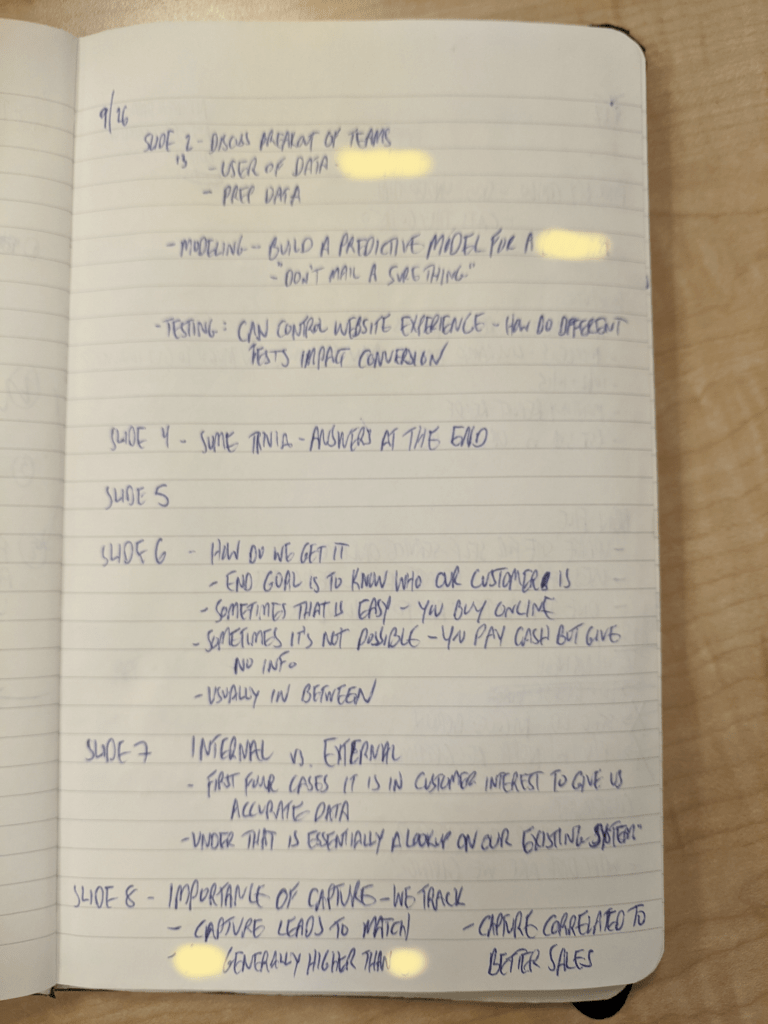
You get one point per slide
One point. That’s all anyone is going to remember, especially as your presentation goes on. Look at each slide in your presentation and ask yourself “Why is this here and how does it further my story”
It’s going to be tempting to tell everyone about how you figured this part out or explain the code that you wrote or share an interesting, but non-relevant, nugget of knowledge you found….but resist that temptation. You’re telling a story (see point #1) and there are no side quests.
Your slides are for support and not a script
This is another version of “don’t read your slides” but I have to include it because people keep doing it. You can have as much text and as many supporting figures as you’d like in your slides but you are not allowed to read them line by line. At all.
There is no shortcut for practice and preparation
Since you can’t read your slides that means you need to practice what you’ll say instead. You can do this however you like – in front of a mirror, to your dog, while you sit in traffic. You’ll quickly learn which ways work for you. Give yourself time here and don’t start it the day before.
Personally a few days in advance I print my materials and find a small conference room. I go in alone and flip the pages while jotting notes of what I’ll generally say on each page. With that figured out, I start reciting to myself over and over.
During Your Presentation – How to Nail the Big Day
Set it up at the beginning.
The best advice I’ve ever heard about presenting is the following:
- Tell them what you’re going to tell them
Just a couple sentences here where you literally say “Today I’m going to walk through X. You’re going to see in the slides that Y and Z have happened which is why we’re recommending that we do A.” That’s really all it takes. Your goal here is to pre-seed your audience with your story. - Tell them
Give that presentation you’ve practiced for! - Tell them what you just told them
Again, this is a simple as “We’ve gone over X. I’ve just showed that we saw Y and Z happening. And because we can measure that, we suggest doing A.”
It’s human nature to remember the first and last parts of something. By restating your point at the beginning and end of the presentation you’re making it stick with your audience and that’s the whole reason you’re doing this.
Be yourself
You know what you’re going to say and you’ve practiced so relax and be yourself. There are a lot of articles about developing a presentation style. It’s my opinion that if you confidently know your material and can relax while delivering it you’ll have your own authentic style
Remember that everyone is rooting for you
If you’re still nervous remind yourself that the audience wants you to succeed. Remember our article above; some of them would rather be dead than trade places with you!
After the Presentation – Wrapping It Up Cleanly
Questions – you want some
Have you been in a meeting where the speaker finishes, asks if there are questions and gets an indifferent silence in return? That’s not great. Sure, it’s nice to think that your presentation was so thorough that every person who witnessed it is convinced. The reality is it’s more likely that you lost them on the way.
Now, earlier I told you that you can fill your slides with text and figures but that you can only cover a single point and that you should avoid side-questing your presentation. Here’s where you get to go as deep and as sideways as you’d like!
While you spoke your audience shifted their attention between your words and your slides. Since you didn’t read the details it’s likely that someone will ask about them. And of course you’ll easily field that question by referring back to the relevant slide and saying “glad you asked, if you go back to slide number and look at this figure…”.
Enjoy the moment…then do it again
If you’ve followed these steps and had a good presentation, it will feel good when you’re done. Take a moment to appreciate that feeling, you’ve earned it.
Then get ready for your next presentation. The more you do this the easier it will get!
 Amateur Data Science
Hey, great read! I particularly enjoyed your in-depth discussion of the storytelling presentation approach, since it was something I hadn’t really thought of before. Being a fellow blogger myself, I also really appreciate how organized and well-formatted everything was – it definitely made the content much more digestible overall. Keep up the awesome work!
LikeLike